Private Credit Is Cracking. Here’s What It Means for Construction Lending
The Wall Street Journal reported this week that loan defaults inside the largest private credit funds (Ares, Blackstone, Blue Owl, and Golub) have hit their highest level since at least 2021. Fund managers are publicly split on what it means. One CEO put it plainly: this is a credit cycle, not a collapse, but there will be winners and losers.
That’s the headline. It’s not the whole story for construction lenders, and if you only read the headline, you’ll draw the wrong conclusion about your own risk.
Private credit is not one market. It’s several very different markets wearing the same label. Some of them are stressed right now. One of them, the one most construction lenders touch, is doing the opposite. Both things are true at once, and the gap between them is where the real risk is hiding.
What “Private Credit” Actually Means
Most people hear “private credit” and picture one thing: a fund lending money to a company instead of a bank doing it. That’s direct lending, and it’s the largest, oldest, and most familiar piece of the market. It’s also where the WSJ’s data is coming from: corporate loans to mid-market companies, mostly outside real estate entirely.
But direct lending is only part of the picture. The other fast-growing piece is asset-based finance (ABF), lending secured by pools of assets and their cash flows rather than a single company’s balance sheet. That umbrella covers a wider range than most people assume: consumer and credit card receivables, auto and equipment loans, aircraft and railcar leases, data centers, and infrastructure financing. Closer to home, real estate credit, including construction/fix-and-flip and bridge lending, represents its own distinct vertical.
There’s also mezzanine debt, venture debt, distressed debt, and specialty finance strategies layered on top. Real estate-focused private credit, the funds and debt vehicles construction and CRE borrowers deal with, is its own distinct lane inside that broader universe.
That distinction matters enormously right now, because the WSJ story is describing stress in one lane while a different lane is expanding.
The Two-Year Contraction, By the Numbers
Look at direct lending, the corporate strategy at the center of the WSJ piece, over the last two years, and the pullback is clear:
-
Fund formation has collapsed. New private credit fund closings fell from roughly 255 funds in 2023 to about 200 in 2024, and just over 150 through 2025: a two-year decline of nearly 40%, according to Bloomberg’s Private Credit Annual Report.
-
Fundraising has followed the same path. Global private credit fundraising peaked above $330 billion in 2023, fell to roughly $150 billion in 2024, and is tracking below $100 billion for 2025: a contraction of well over half in two years.
-
Direct lending’s share of new capital has been cut in half. As recently as 2024, direct lending accounted for close to 60% of all private credit capital raised. By early 2026, that share had fallen to roughly 30%, with capital rotating into asset-based finance, infrastructure debt, real estate credit, and special situations instead.
-
Retail money is heading for the exits. Redemptions from non-traded business development companies (BDCs), the vehicles many individual investors use to access private credit, roughly tripled in a single quarter at the end of 2025, and several funds paid out redemptions above their standard quarterly caps.
-
Borrower health is deteriorating at the same time capital is pulling back. Nonaccrual loan rates at the largest public BDCs are at their highest level since at least 2021, and the number of borrowers on internal “watch lists” at several major managers is at its highest point since 2022–23, while the broader U.S. economy is still performing well. That combination, rising stress in a good economy, is the part fund managers are quietly worried about, because it suggests less cushion if growth slows.
That’s a real, two-year contraction. It’s concentrated in corporate direct lending, and it’s happening at exactly the moment the largest managers need investor confidence the most.
What’s Happening in Residential, Commercial, and Multifamily
Here’s where it gets more nuanced, because construction and real estate lending is not moving in the same direction as corporate direct lending.
Residential fix-and-flip: This segment isn’t seeing a private-credit pullback so much as a margin squeeze from the housing market itself. Rising construction costs, higher rates for the end buyer, and slower resale in a growing number of metros mean the underwriting assumptions from 18–24 months ago no longer hold for a lot of spec and fix-and-flip projects. That’s a project-economics problem more than a capital-availability problem, for now! But it’s exactly the kind of environment where a capital pullback at the fund level would hit hardest, because smaller residential borrowers have the fewest alternative sources of financing.
Commercial real estate, broadly: Private credit isn’t retreating from CRE; it’s accelerating into it. Private market lending to commercial real estate surged over 130% year-over-year in the first quarter of 2026, even as bank CRE lending simultaneously rose sharply. Roughly $875 billion in commercial mortgages are scheduled to mature in 2026, representing the largest refinancing wave on record, and private lenders are stepping in with bridge loans, mezzanine positions, and gap financing behind bank senior debt. An estimated $585 billion in CRE-focused private credit dry powder remains available for deployment. This is the opposite of what the WSJ headline implies!
Multifamily: Multifamily is one of the biggest beneficiaries of that private credit expansion. Bank CRE lending fell to an 11-year low in late 2024 as higher land, labor, and material costs combined with looming capital requirements under Basel III Endgame pushed banks to pull back specifically from construction and transitional lending. Private credit stepped into that gap and has stayed there. At the same time, roughly 18% of the $126.6 billion in distressed CRE tracked in Q3 2025 was multifamily, and highly leveraged owners who bought or refinanced during the low-rate era are increasingly running out of runway to “extend and pretend” their way to a better market.
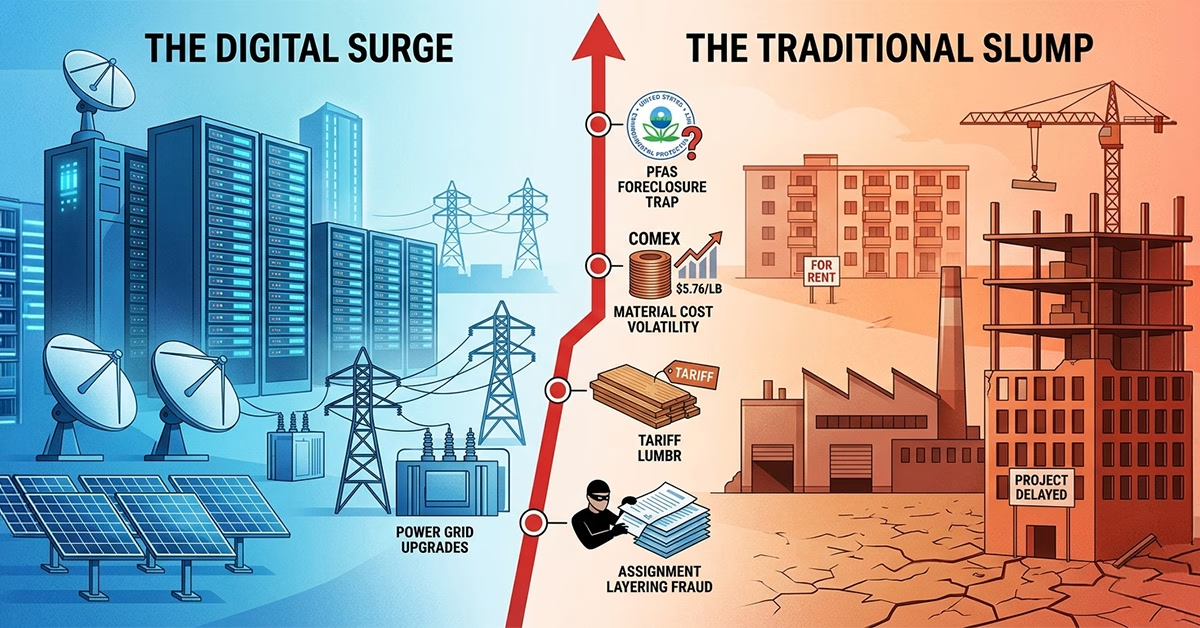
The short version: Corporate private credit is contracting. Real estate and construction-focused private credit is expanding into space banks have vacated. Those are two different credit cycles happening under one label.
What Could Happen in Construction Lending From Here?
This is where I might push back on complacency, even though today’s data looks fine for construction and CRE-focused private credit.
Several of the same platforms under stress in the WSJ story (Ares, Blackstone, Blue Owl, and KKR) also manage real estate and asset-based finance funds. Capital, confidence, and fundraising capacity aren’t perfectly walled off inside one manager. As analysts evaluating contagion risk point out, if retail redemption pressure and fundraising fatigue in corporate direct lending damage a manager’s overall standing with LPs, that can tighten the spigot for that same manager’s real estate and construction-focused vehicles too, even if those vehicles are performing fine on their own merits. Fundraising fatigue tends to be a firm-level problem before it’s a strategy-level one. Think about this!
There’s also the timing risk the article itself flags: default and watchlist stress is rising while the economy is still healthy. If growth slows, and construction is one of the most cyclical, rate-sensitive sectors there is, a private credit market that is already showing cracks in a good economy has less room to absorb a bad one!
And construction lending specifically has the least room to fall back on banks if private credit does tighten. Basel III Endgame is pushing banks away from construction and transitional lending on purpose, and that’s not a temporary posture; it’s a regulatory direction. If private capital pulls back at the same time banks are structurally retreating, construction borrowers (especially smaller, regional, and residential sponsors) are the ones with the fewest remaining doors to knock on.
The Alternative Worth Looking At
In my opinion, none of this means abandoning private credit as a capital source for construction. It means being deliberate about which lane of it you’re relying on, and how that capital is structured and controlled at the loan level.
Two things are worth evaluating as a lender right now:
-
Diversify your capital relationships, not just your loan book. If your construction lending capacity runs primarily through one or two large multi-strategy platforms, you’re more exposed to firm-level fundraising stress than you might think, even if your specific loans are performing. Regional banks, credit unions, family offices, and smaller dedicated real estate credit funds are a genuine alternative source of capital precisely because they aren’t managing a corporate direct lending book that could spook their own investors.
-
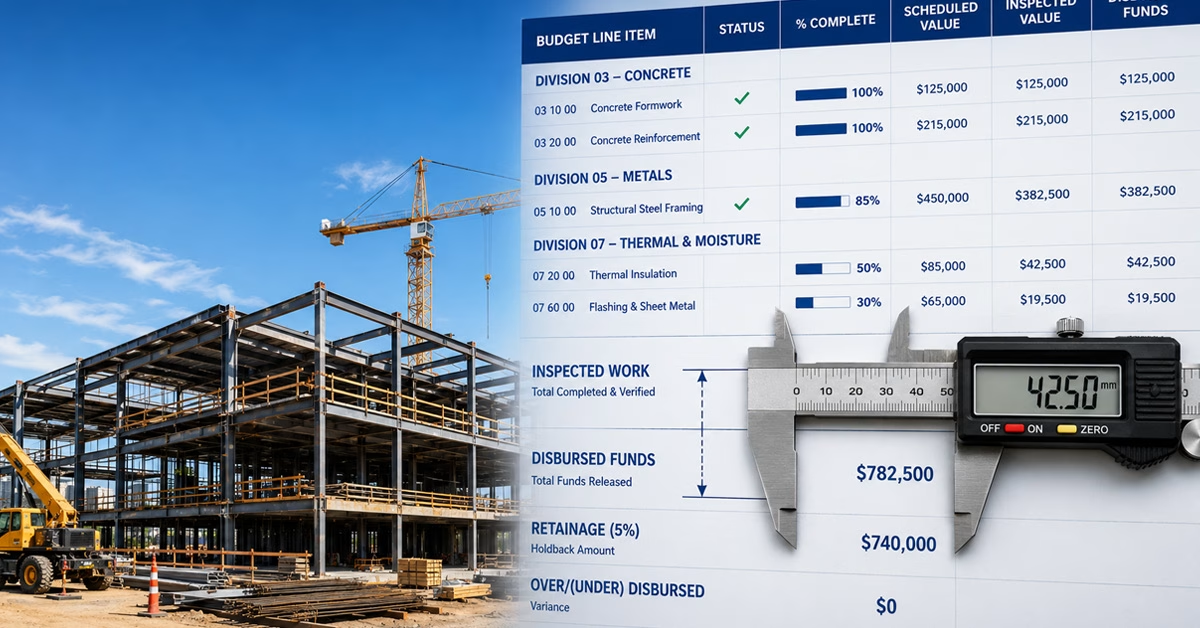
Tighten fund control regardless of where the capital comes from. The lenders who get hurt in a credit cycle aren’t usually the ones with bad capital; they’re the ones with weak verification. Rigorous draw inspection, documented percent-complete, and disbursement controls that don’t rely on relationship trust protect a loan’s collateral value no matter what’s happening two levels up at the fund level. That discipline matters more, not less, when the capital funding your warehouse line is coming from a platform under its own pressure to show liquidity.
Private credit didn’t cause the stress in construction lending. But a credit cycle is exactly the environment where undisciplined fund control gets exposed on both sides of the capital stack. Don’t get caught on a sandbar when the tide goes out!