How Disciplined Draw Administration Keeps Construction Projects Financially Viable
A construction loan can be properly underwritten and still fail during execution.
The approved budget may have been reasonable. The collateral may have supported the original loan. The borrower may have contributed the required equity. The contractor may have looked qualified. Then the draws begin.
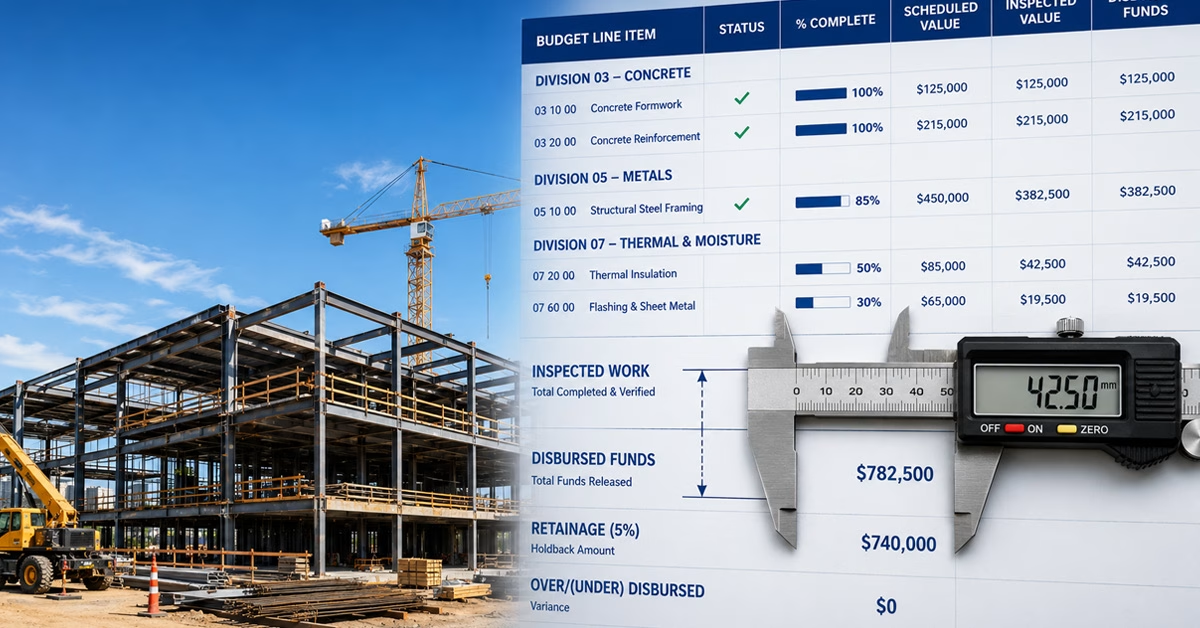
Invoices arrive without supporting documentation. Contractors request funds ahead of verified progress. Change orders consume contingency. Subcontractors remain unpaid. The project falls behind schedule while the percentage of loan proceeds disbursed moves ahead of the percentage of work completed.
By the time the lender recognizes the pattern, the remaining loan balance may no longer be sufficient to finish the project.
That is the risk fund control is designed to manage.
What Is Construction Fund Control?
Construction fund control is the disciplined process of reviewing, approving, documenting, and administering construction loan disbursements so that funds are released only for eligible project costs supported by verified progress and adequate documentation.
Fund control connects four elements that lenders cannot afford to evaluate separately:
-
The approved construction budget
-
The physical progress of the project (aka Inspection)
-
The documentation supporting each draw request
-
The amount of money remaining to complete the work
A properly administered fund-control process does more than move money. It helps the lender answer a more important question: After this draw is funded, will sufficient capital remain to complete the project and protect the lender's collateral?
Federal banking guidance has long identified formal loan administration, inspections, budget comparisons, lien controls, segregation of duties, and properly authorized disbursements as central components of sound construction lending. Regulatory guidance also emphasizes that remaining funds should be continually evaluated against the amount required to finish construction. Fund control is therefore not merely a payment service—it is an ongoing risk-management function.
Why Construction Loans Require More Control Than Conventional Loans
A conventional real estate loan is generally secured by a substantially completed asset. A construction lender, by contrast, advances capital against an asset that is changing every day.
The lender is exposed to several moving risks:
-
The project budget may become outdated.
-
Labor and material costs may increase.
-
Work may be delayed.
-
Contractors or subcontractors may experience financial distress.
-
Loan proceeds may be diverted to another project.
-
The borrower may submit duplicate or unsupported invoices.
-
Change orders may alter the original scope.
-
Permits or approvals may expire or remain incomplete.
-
Mechanics' liens may impair the lender's collateral position.
-
The remaining loan funds may become insufficient to finish construction.
Construction lending guidance identifies contractor capacity, diversion of progress payments, fraud, cost overruns, delays, and failure to complete within budget as significant risk factors. It also identifies draws requested ahead of schedule and adverse inspection findings as warning signs that deserve lender attention. The lender is not simply financing real estate; it is financing a production process involving multiple companies, documents, deadlines, payment obligations, and physical milestones.
Fund control creates discipline around that process.
Fund Control, Draw Management, and Draw Inspections Are Not the Same Thing
These terms are frequently used interchangeably, but they describe different functions.
Draw Inspection
A draw inspection evaluates observable construction progress at the project site. The inspector typically documents completed work, reports percentage complete by budget category, photographs relevant improvements, and notes visible concerns at a specific moment in time.
The inspection answers: What work appears to have been completed?
Draw Management
Draw management is the broader workflow used to receive, organize, review, communicate, approve, and track draw requests. It may include:
-
Draw submission
-
Document collection
-
Inspection coordination
-
Budget tracking
-
Exception management
-
Approval routing
-
Borrower and contractor communication
-
Reporting
-
Payment instructions
The draw-management process answers: What must happen before this request can be approved or rejected?
Fund Control
Fund control addresses the financial administration of the construction proceeds. It compares the requested disbursement against the approved budget, completed work, invoices, lien documentation, prior payments, borrower equity requirements, remaining funds, and lender instructions.
Fund control answers: How much should be released, to whom, and under what conditions?
Integrating the Functions
A site inspection alone is NOT fund control. A photograph does not prove that a subcontractor has been paid, an invoice is legitimate, a change order was approved, or sufficient money remains to complete the project.
Likewise, software that routes a draw request does not independently determine whether the underlying request is financially justified. Effective construction loan administration requires these functions to operate together.
The Eight Core Components of Construction Fund Control
1. Establishing the Approved Project Budget
Fund control begins before the first draw. The lender needs a sufficiently detailed budget that identifies the major hard costs, soft costs, permits, professional fees, contingency, interest reserve, and other project-specific expenses.
A budget that is too broad creates weak controls. A single line labeled "construction costs" cannot be meaningfully compared with invoices, inspection progress, or remaining obligations.
The budget should be reviewed for:
-
Scope completeness
-
Mathematical accuracy
-
Regional cost reasonableness
-
Alignment with plans and specifications
-
Contractor overhead and profit
-
Permit and impact fees
-
Utility and site-work requirements
-
Adequate contingency
-
Appropriate interest reserves
-
Potentially front-loaded line items
Regulatory guidance calls for specific, reasonable, and supportable cost estimates that allow the lender to understand the nature of project costs and their contribution to collateral value.
2. Confirming Borrower Equity (Prior to Loan Closing)
Loan documents commonly require the borrower to contribute a defined amount of equity before or alongside lender advances. Fund control should track whether that equity was actually contributed and whether the contribution involved eligible project costs.
A bank statement showing available cash is not the same as proof that the money was invested in the project. The review may require:
-
Paid invoices
-
Wire confirmations
-
Settlement documentation
-
Receipts
-
Bank records
-
Contractor acknowledgments
-
Evidence of land or material contributions, when permitted
Poor equity tracking can result in the lender funding more of the project than originally approved.
3. Reviewing the Draw Request
Each draw request should be tested against the approved loan structure and prior activity. The review normally considers:
-
The amount requested by budget line
-
Prior approved draws
-
Current committed costs
-
Approved and pending change orders
-
Remaining budget
-
Available contingency
-
Inspection percentages
-
Stored materials
-
Retainage requirements
-
Previously identified exceptions
-
Borrower and contractor certifications
The objective is not simply to confirm that arithmetic adds up. The reviewer must determine whether the request is consistent with the project's actual financial and physical position.
4. Verifying Physical Progress
The draw inspection provides independent evidence of work completed at the site. The inspector should evaluate the relevant budget categories, document observed progress, photograph the work, and identify discrepancies or conditions that require further review.
Sound construction lending guidance recommends comparing inspection reports with plans and specifications before disbursement. Inspection reports should support the requested advance and indicate whether the project is progressing as expected. Inspection evidence should be evaluated carefully.
A reported percentage complete is an informed field assessment—not a guarantee of workmanship, code compliance, legal compliance, or final project cost.
The lender should also distinguish between:
-
Work physically incorporated into the project
-
Materials stored securely on-site
-
Materials stored off-site
-
Deposits for work not yet completed
-
Contractor mobilization
-
Design or professional services
-
Work that cannot be readily observed after installation
5. Validating Invoices and Payment Documentation
Invoices should be reviewed for consistency with the approved budget, contractor agreement, draw request, and inspection findings. Common issues include:
-
Duplicate invoices
-
Altered invoices
-
Costs assigned to the wrong project
-
Unsupported deposits
-
Payments requested for incomplete work
-
Charges outside the approved scope
-
Mathematical inconsistencies
-
Unapproved markups
-
Costs previously funded
-
Vendor names that do not match contracts or lien documentation
Invoices provide evidence of an amount billed. They do not, by themselves, prove that the work was completed, the cost was reasonable, or the vendor was paid. Fund control should reconcile documentation rather than treating each document as an isolated approval item.
6. Managing Lien Waivers and Title Risk
Contractors, subcontractors, laborers, and suppliers may have rights to assert mechanics' liens when they are not paid. A construction lien can create an interest in the property securing the loan. State-specific rules, required forms, timing, and legal effect of lien waivers vary by state. Lenders should rely on qualified legal and title professionals for jurisdiction-specific requirements.
Operationally, fund control may include:
-
Conditional progress-payment waivers
-
Unconditional waivers for prior payments
-
Final-payment waivers
-
General contractor affidavits
-
Subcontractor and supplier waivers
-
Notices to owner
-
Notices of commencement
-
Title updates or date-down endorsements
-
Review of newly recorded liens
-
Confirmation that previous payments reached the intended parties
A waiver from the general contractor may not address every potential claimant. The required documentation should reflect the project structure, applicable law, lender instructions, and title-company requirements. Regulatory construction lending guidance specifically identifies receipted bills, lien waivers, title protection, and the release or clearing of liens as important disbursement controls.
7. Monitoring Change Orders and Contingency
Change orders are a normal part of construction. Uncontrolled change orders are a common path to project failure.
Each change order should be evaluated for:
-
Description of the scope change
-
Reason for the change
-
Pricing support
-
Contractor and owner approval
-
Effect on the project schedule
-
Impact on permits or plans
-
Funding source
-
Effect on contingency
-
Effect on the remaining cost to complete
A change order does not create new loan proceeds. When scope expands without a corresponding funding source, the lender may be left with a partially completed project and an exhausted budget.
Pending change orders also matter. A project can appear adequately funded only because known future costs have not yet been formally approved or entered into the budget.
8. Performing a Cost-to-Complete Analysis
Cost-to-complete analysis is the financial heartbeat of fund control. The analysis asks whether the undisbursed loan proceeds, remaining borrower equity, documented contingency, and other verified sources are sufficient to complete the remaining work.
A simplified analysis is:
The analysis should consider more than the unused balance of each budget line. It may also require adjustments for:
-
Known cost increases
-
Pending change orders
-
Unpaid invoices
-
Retainage
-
Rework
-
Damaged materials
-
Schedule extensions
-
Interest-reserve depletion
-
Contractor replacement costs
-
Permit corrections
-
Professional fees
-
Temporary protection or security
-
Market escalation
A project can be "in balance" mathematically while still being underfunded economically.
For example, an electrical budget may show $200,000 remaining. If updated bids indicate that the remaining electrical scope will cost $275,000, the project already has a $75,000 shortfall, even though no budget line has technically been overdrawn. Fund control should identify that deterioration before the money is gone.
What a Sound Construction Draw Process Looks Like
A disciplined draw process generally follows this sequence:
Step 1: Receive the Complete Draw Package
The package may include:
-
Borrower draw request
-
Contractor payment application
-
Updated schedule of values
-
Invoices
-
Change orders
-
Lien waivers
-
Proof of prior payments
-
Updated project schedule
-
Permit documentation
-
Stored-material documentation
-
Borrower certification
Incomplete submissions should be identified promptly rather than allowed to sit in an informal approval queue.
Step 2: Reconcile the Request to the Approved Budget
The reviewer compares current requests, prior funding, committed costs, and remaining balances. Any transfer between budget categories should follow the lender's approval requirements.
Step 3: Conduct and Review the Inspection
Inspection findings should be reconciled against the draw request, invoices, plans, and budget categories. Material discrepancies should be resolved before funds are released.
Step 4: Review Lien and Title Documentation
Required lien waivers, title updates, affidavits, and related documentation should be evaluated under lender and jurisdiction-specific requirements.
Step 5: Update the Cost-to-Complete Analysis
The reviewer determines whether sufficient verified funding remains after the proposed advance.
Step 6: Identify Exceptions
Exceptions may include:
-
Requested progress exceeding inspected progress
-
Missing lien waivers
-
Unapproved change orders
-
Budget overruns
-
Insufficient contingency
-
Expired insurance
-
Permit issues
-
Schedule delays
-
Duplicate invoices
-
Unverified stored materials
-
Geographic inconsistencies
-
Evidence of contractor or borrower distress
Step 7: Issue a Funding Recommendation
The recommendation may approve the full request, approve a reduced amount, place conditions on funding, or recommend that the draw be held pending additional information.
Step 8: Obtain Lender Authorization
The lender retains the credit decision and final authority to release funds. An outside fund-control provider can review evidence, identify exceptions, administer documentation, and make a funding recommendation. It does not replace the lender's legal responsibilities, underwriting judgment, or final approval authority.
Step 9: Document and Reconcile the Disbursement
Following approval, payment information should be recorded accurately and reflected in the loan's remaining budget.
Some programs use direct payments to contractors, subcontractors, or suppliers. Others reimburse the borrower or use title-company disbursement channels. The payment method should match the lender's documented control structure.
Eleven Warning Signs Fund Control Should Catch
A single exception does not always mean that a project is failing. Patterns matter. Lenders should pay close attention when they observe:
-
The percentage of funds disbursed exceeds the percentage of work completed.
-
Draw requests consistently arrive ahead of the construction schedule.
-
The contractor requests unusually large deposits.
-
Invoices lack sufficient project detail.
-
The same invoice number or amount appears more than once.
-
Lien waivers are missing, inconsistent, or signed by the wrong entity.
-
Change orders repeatedly consume contingency.
-
The project schedule is extended without updating interest and carrying costs.
-
Inspection findings conflict with the draw request.
-
Subcontractors report nonpayment despite previous advances.
-
Remaining funds appear insufficient to complete the remaining work.
Regulatory guidance similarly identifies draws requested ahead of schedule, inspection findings that depart from approved specifications, diversion of proceeds, contractor inability to complete within budget, and inadequate remaining funds as material construction lending concerns. The goal of monitoring and using fund control is not to predict every failure; it is to identify developing risks while the lender still has options.
Common Fund-Control Mistakes
Treating Fund Control as Document Collection
A complete file is not necessarily a safe draw. Documents must be reconciled against one another, the budget, the inspection, and prior disbursements.
Relying Solely on the Borrower or Contractor
Borrowers and contractors possess essential project information, but they are not independent control functions. Independent review becomes more important when the project is delayed, over budget, or experiencing payment disputes.
Funding From Inspection Percentages Alone
Inspection progress is only one part of the draw decision. The lender must also evaluate invoices, prior payments, lien exposure, remaining costs, change orders, and loan-document requirements.
Ignoring Small Discrepancies
Major losses often begin as small unresolved exceptions:
-
A missing waiver
-
A minor budget transfer
-
An undocumented deposit
-
A pending change order
-
A schedule delay
-
A contractor requesting funds slightly ahead of progress
Repeated tolerance turns exceptions into operating practice.
Waiting Until a Budget Line Is Exhausted
By the time a budget category reaches zero, the underlying problem may already be severe. Forward-looking cost-to-complete analysis should identify emerging shortfalls before the approved budget is fully consumed.
Allowing Unclear Accountability
The borrower may assume the contractor submitted a document. The contractor may assume the title company handled it. The lender may assume the fund-control provider verified it.
Unclear ownership is itself a control failure. Each party should know who collects, reviews, approves, escalates, funds, and records every material draw component.
Human Review, Software, and AI: Clear Roles Matter
Technology can significantly improve construction loan administration.
Software
Software can:
-
Centralize draw submissions
-
Track required documents
-
Route approvals
-
Maintain budget histories
-
Coordinate inspections
-
Flag missing information
-
Record exceptions
-
Preserve audit trails
-
Improve communication
-
Reduce repetitive data entry
AI Systems
AI-supported systems may assist with:
-
Document classification
-
Invoice extraction
-
Duplicate detection
-
Budget reconciliation
-
Anomaly identification
-
Geographic and image verification
-
Pattern detection
-
Exception prioritization
-
Drafting summaries
The Need for Human Review
These tools can improve speed and consistency. They do not eliminate the need for accountable human judgment or Human-in-the-Loop (HITL) review.
A system can identify that two invoices contain similar amounts. A qualified reviewer must determine whether they represent a duplicate, a legitimate progress billing, or two separate vendors.
A model can flag a mismatch between inspection progress and requested funding. The lender must decide whether to reduce the draw, obtain additional evidence, restructure the budget, or stop advancing funds.
The appropriate model is:
-
Technology organizes the evidence.
-
AI helps identify patterns and exceptions.
-
Experienced professionals interpret the project.
-
The lender makes the final decision.
When Should a Lender Use an Independent Fund-Control Provider?
Independent fund control may be especially valuable when:
-
The lender does not maintain a specialized internal construction administration team.
-
Loan volume exceeds internal operational capacity.
-
Projects are located across multiple states.
-
The lender finances unfamiliar property types.
-
Draws involve multiple contractors and subcontractors.
-
The loan requires title-company coordination.
-
The project has experienced delays or cost overruns.
-
The borrower or contractor has limited construction experience.
-
The lender needs documented segregation of duties.
-
The portfolio requires consistent reporting and escalation.
-
The lender wants an independent review between the borrower's request and the final disbursement decision.
The provider should have practical construction lending experience, not merely payment-processing capability.
Questions to Ask a Fund-Control Company
Before selecting a provider, lenders should ask:
-
Does the company perform fund control, draw inspections, or both?
-
How are inspections reconciled with invoices and the approved budget?
-
How does the company monitor cost to complete?
-
How are change orders and contingency handled?
-
What lien-waiver and title documentation can the company administer?
-
How are duplicate invoices or suspicious documents identified?
-
How are exceptions communicated and escalated?
-
Does the company support residential, commercial, multifamily, and land-development projects?
-
Can it provide nationwide inspection coverage?
-
What information is included in the funding recommendation?
-
How are responsibilities divided between the provider and lender?
-
Does the system maintain a defensible audit trail?
-
How does the provider protect confidential borrower and project information?
-
What happens when the inspector's findings conflict with the draw request?
-
Can the provider support troubled-project and cost-to-complete reviews?
The cheapest provider is not always the lowest-cost option. A weak review that releases funds against unsupported progress can create exposure far exceeding the administrative fee saved.
CFSI's Operational Approach to Fund Control
CFSI Loan Management supports construction lenders through an integrated process that can include contractor review, project feasibility analysis, fund control, draw inspections, cost-to-complete analysis, environmental due diligence, and portfolio oversight.
CFSI's fund-control process is designed to connect:
-
The lender's approved budget
-
Loan-document requirements
-
Borrower equity
-
Contractor payment requests
-
Inspection evidence
-
Invoices
-
Change orders
-
Lien documentation
-
Title requirements
-
Prior disbursements
-
Remaining project costs
CFSI provides the operational review and supporting recommendation. The lender maintains final authority over credit decisions and the release of loan proceeds.
This distinction matters! Effective fund control should strengthen the lender's decision, not obscure who is accountable for making it.
The Bottom Line
Fund control is not a clerical layer added after underwriting. It is the operating system that helps preserve the assumptions made when the construction loan was approved.
A sound fund-control process helps the lender determine:
-
Whether the requested work has been completed
-
Whether the requested costs are supported
-
Whether prior payments reached the intended parties
-
Whether lien and title risks are being managed
-
Whether change orders remain funded
-
Whether borrower equity has been contributed
-
Whether sufficient funds remain to finish construction
-
Whether the proposed advance should be approved, reduced, conditioned, or declined
The most important draw is not necessarily the largest draw. It is the draw after which the lender no longer has enough money or enough leverage to correct the project.
Disciplined fund control is designed to prevent the loan from reaching that point.
Frequently Asked Questions (FAQ)
Sources and Further Reading
- Office of Thrift Supervision, Examination Handbook 213: Construction Lending.
- Office of the Comptroller of the Currency, Comptroller’s Handbook: Commercial Real Estate Lending.
- Federal Deposit Insurance Corporation, Construction and Land Development Lending.
- Legal Information Institute, Cornell Law School, overview of construction liens.
- CFSI Loan Management, construction loan management and risk-mitigation services.
Important notice: This guide is intended for general construction lending and risk-management education. It does not constitute legal, regulatory, engineering, accounting, title, or credit advice. Requirements may vary according to loan documents, lender policies, project type, and state law.