A White Paper on Draw Inspections, Structural Delays, and the AI Transformation in Commercial Lending
The disbursement of capital in construction lending represents one of the most complex risk management functions in real estate finance. Unlike traditional mortgage lending, where funds are fully advanced at closing against an existing asset, construction financing relies on incremental disbursements tied to progressive value creation. The draw inspection is the primary operational mechanism used to determine whether physical completion on the job site corresponds with requested budget allocations.
When misalignments occur between reported progress and actual field conditions, financial institutions face heightened credit, legal, and operational risks. This white paper examines the structural mechanics of draw and status inspections, analyzes the operational breakdown caused by stale photographic documentation, outlines strategies for stakeholder alignment, contrasts administrative friction with essential fraud prevention, and maps the transformational role of artificial intelligence in modern construction risk management.
The Core Imperative of Construction Draw Inspections
Construction loan management operates on a fundamental principle: lenders fund verified progress, not reported progress. The draw inspection serves as an independent control measure designed to validate that work claimed on a billing statement actually exists on the physical site before capital is released. By sending qualified third-party inspectors to evaluate field conditions, lenders protect their collateral position, ensuring that the remaining undisbursed loan balance is always sufficient to complete the project should default occur.
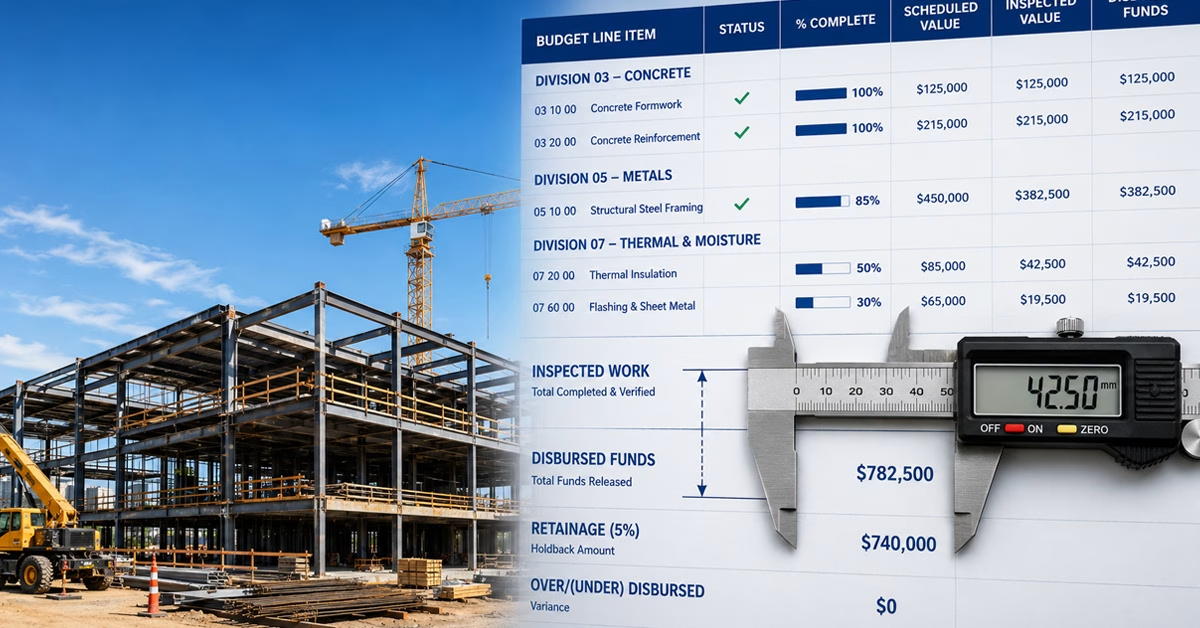
The drawdown lifecycle follows a rigid operational sequence. It begins when the borrower or general contractor submits a formal draw request containing an updated Schedule of Values (SOV), progress billings, subcontractor invoices, and lien waivers. The lender performs an initial administrative document review to verify budget consistency. Once pre-draw documentation is validated, an independent third-party inspection is dispatched to the job site. The inspector conducts a visual audit, takes progress photographs, and evaluates physical completion against the billing categories. If the verified completion matches the draw request, the lender approves the disbursement. Conversely, if progress falls short of the requested amount, the lender intervenes to scale back the disbursement according to internal risk policies.
Milestone vs. Percentage-of-Completion Draw Frameworks
Lenders utilize two distinct structural frameworks to evaluate progress and release funds, depending on project scale, structural complexity, and property type.
Draw Inspection Frameworks Comparison
1. Milestone-Based Draws
-
Primary Application: Residential construction, custom single-family builds, and simple renovations.
-
Structural Mechanics: Capital is released in fixed disbursements upon 100% completion of predetermined structural phases (e.g., Foundation 15%, Framing 25%, Rough-Ins 20%).
-
Risk & Verification Dynamics: Binary verification. Inspection confirms whether the milestone is fully met. Capital is withheld entirely for incomplete milestones, placing cash-flow burdens on contractors if phases are delayed.
2. Percentage-of-Completion Draws
-
Primary Application: Commercial developments, multi-family builds, and complex multi-trade projects.
-
Structural Mechanics: Capital is released monthly based on incremental percentage completion across a detailed Schedule of Values (SOV) covering multiple sub-trades simultaneously.
-
Risk & Verification Dynamics: Continuous verification. Requires granular analysis of individual line items (e.g., HVAC 80% complete, Electrical 40% complete) using standardized completion grids.
In percentage-of-completion environments, inspectors utilize standardized completion grids to evaluate progress across distinct categories, including site work, structural foundations, framing, exterior enclosure, mechanical, electrical, plumbing (MEP), and interior finishes. The inspector evaluates the physical work in place and assigns a completion percentage to each line item, which is then cross-referenced against the contractor’s schedule of values.
Empirical Impact of Inspections on Default Mitigation
The financial value of rigorous, frequent site verification extends beyond immediate draw approvals. Empirical research underscores the direct link between monitoring frequency and credit performance. A study conducted by the FDIC’s Center for Financial Research (Heitz, Martin, & Ufier, 2022) revealed that increasing third-party on-site inspections from two to three per 100 days reduced the probability of loan default by 3.64 percentage points.
The underlying systemic driver of this default reduction is early anomaly detection. Regular inspections reveal operational warning signs such as disorganized job sites, safety infractions, unauthorized scope changes, or stalled trade before they manifest as financial defaults. When inspectors identify cost overruns early (e.g., an electrical line item that is 80% spent but only 50% physically installed), lenders can intervene to freeze unallocated reserves or mandate contractor equity injections before the loan becomes severely under-collateralized.
The Reconciliation Crisis: Visual “Snapshots” and Ephemeral Data
A primary operational challenge in construction draw management is the temporal decay of inspection data. A progress photograph or inspector report represents an exact snapshot of a job site at a single point in time. In fast-paced construction environments, physical site conditions evolve rapidly. When workflow bottlenecks delay paperwork processing and capital disbursement by several weeks, the initial inspection report loses its validity, creating operational deadlocks.
The Cascade Effect of Stale Inspection Data
When an inspection report becomes stale due to administrative delays, the funding approval process breaks down across multiple operational stages. On Day 1, an inspector visits the job site and verifies that structural framing is 60% complete, prompting the contractor to submit a draw request matching this 60% threshold. However, if missing subcontractor lien waivers, delayed owner authorizations, or internal review backlogs delay loan processing by three weeks, a significant disconnect emerges. During those 21 days, the contractor continues working out-of-pocket, completing the remaining 40% of the framing and initiating mechanical rough-ins.
By the time the lender’s disbursement desk reviews the file on Day 22, the original inspection report is functionally obsolete because it no longer reflects field reality. The contractor typically demands funding for the work performed during the three-week administrative lag to pay arriving subcontractor invoices. Institutional risk policies, however, prohibit disbursing capital for unverified work. Approving only the original 60% framing request leaves the contractor cash-starved for materials and labor already installed on site. Conversely, mandating a complete re-inspection to capture the updated progress imposes additional inspector fees ($300 to $800) and adds another 5 to 15 business days of delay. This operational impasse creates a compounding cycle: delayed paperwork produces stale data, which forces re-inspections, further extending funding timelines and threatening job-site solvency.
Variance Thresholds and Risk-Adjusted Disbursements
To manage minor discrepancies between contractor claims and inspector findings without halting project momentum, institutional lenders apply structured risk-tolerance thresholds. When a draw inspection reveals that a contractor has billed ahead of verified physical completion, internal risk policies dictate whether the draw can be adjusted or if capital must be restricted.
When evaluating a draw request where contractor claims exceed verified field completion, the lender initiates a structured risk evaluation. First, the line-item variance is measured against established policy thresholds. If the line-item discrepancy is within allowable percentage and dollar caps, the lender applies policy flexibility to fund the request, preserving trade relations. However, if the discrepancy breaches variance thresholds, the draw is automatically adjusted downward to match exact inspected completion metrics, protecting the bank’s collateral position.
Risk-Adjusted Disbursement Parameters
1. Line-Item Variance Limit
-
Policy Standard: Maximum 10% upward variance per line item.
-
Operational Execution: Permits funding up to 10% above inspected progress if the absolute variance is under a minimum dollar threshold (e.g., $2,500).
-
Risk Mitigation Function: Prevents minor measurement discrepancies from stalling trade contractor payroll.
2. Cumulative Project Variance Cap
-
Policy Standard: Maximum 10% overall budget variance.
-
Operational Execution: Sum of all line-item variances across the loan history cannot exceed 10% of total disbursements (e.g., $100,000 on a $1M project).
-
Risk Mitigation Function: Restricts total lender overexposure across the entire schedule of values.
3. Pre-Close Exception Monitoring
-
Policy Standard: Mandatory tracking of pre-close borrower/builder exceptions.
-
Operational Execution: Heightens inspection review stringency for projects closed with underwriting exceptions.
-
Risk Mitigation Function: Prevents the compounding of credit exceptions during post-close disbursements.
Mitigating Friction: Welcome Calls and Stakeholder Alignment
Contractors frequently resist formal banking controls, viewing draw inspections, retainage holdbacks, and documentation checklists as administrative hurdles that disrupt trade schedules and squeeze operating cash flow. Lenders, conversely, view these mechanisms as essential safeguards required to maintain loan balance integrity and satisfy regulatory mandates from the FDIC and OCC. Resolving this operational tension requires early alignment among the lender, borrower, general contractor, and third-party inspector before construction begins.
The pre-closing Welcome Call serves as the foundational alignment session where all project stakeholders establish operational protocols. By establishing explicit rules of engagement prior to the first draw request, lenders eliminate systemic misunderstandings that typically cause downstream funding delays.
During the Welcome Call, stakeholders address payment cycle synchronization, document submission standards, inspection lead times, and retainage terms. Contractors often operate on bi-weekly payroll schedules, whereas commercial lenders standardly disburse funds on 30-day cycles. Aligning the draw schedule with actual cash-flow obligations prevents contractors from floating major material costs out-of-pocket. Furthermore, the call establishes explicit expectations for document packages, defining exact requirements for conditional and unconditional lien waivers, invoice backup formats, AIA G702/G703 billing forms, and soft-cost receipts. Stakeholders also agree on fixed cut-off dates for monthly submissions and required inspector access windows, while reviewing the mechanics of the standard 5% to 10% retainage holdback.
Establishing these parameters early builds operational credibility. When contractors understand that draw inspections evaluate honest completion percentages rather than serving as punitive audits, they are less likely to artificially inflate billing numbers, a practice that otherwise triggers automatic draw reductions and compliance reviews.
Root-Cause Analysis of Project Delays
Delays in construction draw disbursements fall into two distinct categories: necessary fraud-prevention delays and unnecessary administrative paperwork delays. Disentangling these categories is essential for optimizing lending operations; necessary delays protect institutional capital, while administrative delays introduce collateral risk.
Necessary fraud-prevention delays occur when a lender intentionally pauses disbursement to investigate financial anomalies, document omissions, or physical misrepresentations. Front-loaded billing is a primary catalyst for fraud-prevention holds. When a contractor bills 80% of a $100,000 masonry allocation but an inspector verifies only 50% physical completion, the lender must pause the draw to prevent uncollateralized capital distribution. Similarly, requests for funding against off-site stored materials require verification of bill-of-sale documents, insurance certificates naming the lender as loss payee, and physical confirmation of segregated storage. Pausing funding until title and custody are established prevents financial losses should a supplier suffer insolvency. Uncollected subcontractor lien waivers and unapproved scope changes represent additional necessary fraud holds. Disbursing capital without collecting waivers for prior disbursements exposes the real estate asset to senior mechanic’s lien claims, while funding unbudgeted cost overruns depletes project contingencies prematurely.
Conversely, administrative paperwork delays stem from inefficient operational workflows, legacy paper processes, and resource bottlenecks within the lending institution or inspection vendor network. Manual spreadsheet tracking represents a widespread source of administrative lag. Reconciling draw requests against static spreadsheets introduces human error and creates review backlogs within the loan administration department. Chasing physical paper lien waivers across dozens of sub-trades creates further friction, often delaying draw approvals by 7 to 10 business days. Furthermore, traditional on-demand inspection models where inspectors are dispatched only after a draw package is submitted introduce an avoidable 5 to 15 business days of site latency. These administrative bottlenecks add no risk-mitigation value and actively degrade project liquidity.
Project Delay Categories & Remediation Strategies
1. Fraud Prevention: Over-Billing & Off-Site Materials
-
Underlying Mechanism: Detection of over-billing, front-loaded draw requests, or unverified off-site materials.
-
Financial & Operational Impact: Pauses disbursement to protect collateral integrity and prevent loan under-collateralization.
-
Strategic Remediation: Enforce strict draw schedule matching and pre-clear long-lead material storage terms.
2. Fraud Prevention: Waivers & Scope Changes
-
Underlying Mechanism: Uncollected subcontractor lien waivers or unapproved budget scope expansions.
-
Financial & Operational Impact: Prevents loss of senior mortgage title priority and preserves emergency loan contingencies.
-
Strategic Remediation: Mandatory pre-approval of scope changes and automated lien waiver collection workflows.
3. Administrative: Manual Budget Tracking
-
Underlying Mechanism: Manual, spreadsheet-based budget tracking and physical invoice reconciliation.
-
Financial & Operational Impact: Extends review cycles by 5–10 business days; introduces manual calculation errors.
-
Strategic Remediation: Deploy cloud-based draw portals featuring automated budget reconciliation engines.
4. Administrative: On-Demand Inspection Dispatch
-
Underlying Mechanism: On-demand inspector dispatch with sequential manual report generation.
-
Financial & Operational Impact: Introduces 5–15 business days of site monitoring latency per draw cycle.
-
Strategic Remediation: Transition to recurring, pre-scheduled interim inspections every 30 to 45 days.
5. Administrative: Sequential Approval Workflows
-
Underlying Mechanism: Paper-based, sequential approval sign-offs among owner, architect, and loan officer.
-
Financial & Operational Impact: Creates document backlogs and extends the funding window beyond the standard 5–7 day target.
-
Strategic Remediation: Implement parallel digital approval workflows with real-time audit tracking.
The Transformational Role of Artificial Intelligence in Draw Management
The integration of artificial intelligence (AI), computer vision, and machine learning into construction lending is transforming draw administration from a reactive, paper-heavy process into an automated, real-time risk platform. Modern AI technologies directly address both the photographic temporal decay problem and administrative operational delays.
Spatial AI and computer vision models are fundamentally altering visual site verification. Rather than relying on periodic, static 2D inspector photos, AI engines ingest continuous visual data captured via 360-degree site cameras, mobile devices, or autonomous aerial drones. Computer vision algorithms automatically overlay these high-definition visual captures directly onto digital Building Information Modeling (BIM) files and CAD architectural blueprints. The AI identifies individual structural components—such as concrete pours, framing studs, drywall panels, and MEP runs—and calculates physical completion metrics automatically. By converting physical site elements into objective progress metrics, spatial AI eliminates human subjective bias and resolves disputes regarding line-item completion percentages. Furthermore, because site visual data can be captured continuously by job-site personnel, the temporal decay of inspection photos is eliminated; when a draw request reaches final review, the AI system cross-references current scan data to confirm that work has progressed, avoiding paid re-inspections.
Simultaneously, Intelligent Document Processing (IDP) powered by machine learning is eliminating administrative paperwork friction. AI document engines parse complex AIA G702/G703 progress billings, subcontractor invoices, and material receipts. The software extracts line-item figures and reconciles them against approved schedule-of-values budgets automatically, instantly flagging instances where requested billing exceeds verified physical completion. Furthermore, machine learning systems match incoming conditional and unconditional lien waivers against trade payout records and land title files, automatically identifying missing documents and requesting digital execution from sub-trades without human intervention.
Predictive risk analytics are also transforming inspection scheduling and portfolio monitoring. Rather than waiting for a contractor to submit a draw request before dispatching an inspector, machine learning models evaluate trade scheduling data, worker density, and historic builder velocity to pre-schedule site visits dynamically. Industry data shows that platforms leveraging pre-scheduled, algorithmically driven inspection models reduce draw-request-to-approval turnaround times by nearly 30% compared to traditional on-demand models. Finally, predictive algorithms track financial burn rates against physical completion curves, identifying micro-trends that indicate underlying project distress. If trade labor expenditures surge while computer vision detects zero advancement in physical installation, the system alerts risk officers to potential capital diversion or concealed rework, enabling proactive intervention before loan default occurs.
Strategic Recommendations and Conclusions
Optimizing construction loan draw management requires balancing rigorous risk controls with efficient capital disbursement. To protect loan portfolios while maintaining strong working relationships with developers and general contractors, financial institutions should adopt the following operational strategies:
-
Mandate Pre-Closing Stakeholder Welcome Calls: Implement formal onboarding calls involving the lender, borrower, general contractor, and third-party monitoring team. Establish clear protocols for documentation standards, inspection schedules, retainage terms, and draw variance rules before funds are advanced.
-
Transition from On-Demand to Pre-Scheduled Inspection Schedules: Replace reactive, post-draw inspection orders with recurring 30-to-45-day pre-scheduled site visits. Pre-scheduled inspections ensure verification data is readily available when draw requests are submitted, compressing total disbursement cycles by up to 30%.
-
Formalize Credit-Adjusted Variance Policies: Establish clear internal risk policies governing allowable line-item and overall project inspection variances. Enforce strict variance caps such as a maximum 10% line-item adjustment up to $2,500 and a 10% cumulative project completion cap to ensure minor discrepancies do not halt project momentum unnecessarily.
-
Deploy AI-Driven Draw Portals: Eliminate manual spreadsheet tracking by transitioning to digital draw management platforms that integrate intelligent OCR, automated lien waiver matching, and computer vision progress analytics.
-
Establish Operational Buffers for Cash-Flow Continuity: Encourage borrowers and contractors to build 5-to-10-day float periods into their project cash-flow forecasts. This buffer absorbs unavoidable administrative or weather-related inspection delays without causing trade payment defaults or job-site shutdowns.
By moving from manual, reactive processes to structured alignment frameworks and AI-enabled site verification systems, commercial construction lenders can effectively mitigate default exposure, maintain title priority, and ensure the efficient flow of capital from loan closing through final project completion.